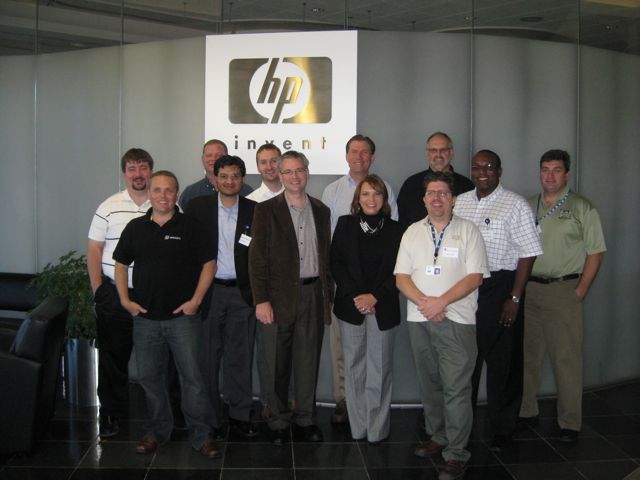
Well that was interesting! I spent Monday and Tuesday with a dozen bloggers in Colorado Springs learning about HP’s key StorageWorks products from the executives and engineers of that storied company. Throughout the event, we listened, asked tough questions, and tweeted incessantly. HP Tech Day generated an avalanche of publicity for the company, including press articles and cries of FUD and misdirection.
Here is the truth: HP and Ivy did a darn fine job of putting together a set of sessions to tell us what they have. They presented folks who really knew their stuff, warts and all. They invited a variety of independent voices and let us ask and say anything we wanted with no expectations, let alone an NDA. This was a stellar event, and every other IT company should be asking why they didn’t do it first.
Won’t Be Fooled
But what was HP Tech Day really all about? Did they brainwash us into thinking the EVA was exciting? Did HP hoodwink and misdirect us from noticing the gaps and overlaps in their product line? Were we dazzled enough to no longer question their storage strategy? Of course not! Robin Harris has seen it all before. Rich Brambley can dissect a presentation with the best of them. Nigel Poulton questions everything he sees. This was not a love-fest, and there were some seriously uncomfortable moments for the HP crew.
We were all savvy enough to know what the score was: HP (and especially their StorageWorks product line) has never received much press or blogger attention. They invited us in to spread the word about their products and get blog exposure. And it worked! The storage Twitter-sphere was dominated with #HPTechDay postings for days, and attendees did indeed blog about the stuff they saw. It was a success from HP’s perspective, and now that we know more about their products we will likely cover them in the future.
I personally never blogged much about HP products. I compared them to Ford, called one product an all-time cool flop, and covered their acquisition of LeftHand and Ibrix, but that’s about it. I didn’t even notice that they had started selling LSI’s StoreAge-based virtualization platform, and didn’t know enough about their other product releases over the last two years to mention them. If it hadn’t been for Calvin Zito and the HP Tech Day, I probably wouldn’t mention them in the future, either. They just weren’t on my radar.
We Were Educated
This has changed as a result of Tech Day. I now know that EVA is still pretty much what I thought it was but that it is fairly simple to configure. I now know that HP has two lines of deduplication appliances, and that one is homegrown. I now know that HP develops and sells a FC SAN virtualization platform based on the LSI/StoreAge product. This was great product exposure for HP: Even though I still don’t think I’ll focus on these offerings, at least I now know that they exist.
We also saw some more interesting content: HP plans to leverage their excellent ProLiant server and blade technology to underpin a line of commodity-based storage and consolidated virtualization offerings. This is exciting stuff, and builds on HP’s base and their recent acquisitions. The most interesting concept I saw was a combination of a blade chassis and ultra-dense storage system with VMware ESX, LeftHand, Ibrix, and HP’s management software. They definitely plan to challenge Cisco/EMC and IBM in this market.
But the best part of the event was the people of HP. The company was smart enough to bring in the techies rather than executive marketing droids. They gave us straight and honest answers about their product capabilities and their place within the company, sometimes to the chagrin of others in the room. We saw conflicting definitions, product line overlaps, internal competition, and got a feel for the realities of this massive company. Every company is like this, but most would never admit what we already know. By not showering us with slick FUD, HP won our respect in a way that I would not have thought possible.
Colorado Take-Away
The event was great. Every other IT company should wise up and do the same. But I bet they won’t have the nerve to do it as openly, and I expect HP will be more careful next time too. As for HP’s products, let me lay out my honest opinion:
- LeftHand was a bargain. HP could replace their entire sub-XP block storage product line with LeftHand variants based on commodity Intel hardware. I think they should.
- Ibrix is too new to judge, but will likely take a seat next to LeftHand in a unified commodity-based scale-out SAN/NAS platform.
- I hope HP hasn’t lost focus on their excellent Hitachi-based XP line, since it’s the only challenger they have to EMC Symmetrix at the high end of the market.
- HP’s excellent server and blade hardware should be leveraged throughout the company and oddball hardware should be curtailed.
- HP has an interesting lineup of Windows Storage Server and Windows Home Server hardware aimed at the low-end SOHO and SMB market. I’m not a Windows hater, but wouldn’t it be cool to have a super-low-end LeftHand variant there too?
- I wonder if HP’s home-grown in-line deduplication (the D2D line) could replace the Sepaton-sourced post-process VLS line or vice-versa if an acquisition of that company happens.
- I don’t “get” SVSP, the LSI/StoreAge SAN virtualization platform. It’s nice and it seems to work, but why introduce a FC SAN virtualization platform at this point? Maybe it sells when integrated with EVA, but not as a standalone product.
- Where are all the storage arrays that use 2.5″ disk drives that HP talked about over the last few years? And where are the flash solid state drives?
- They were like deer in the headlights with no story when I asked about sub-LUN automated tiered storage since even full-LUN automation has not yet been released. Might EMC get there first?
- As for the absence of DCB and FCoE, HP seems to think that Virtual Connect and Flex-10 are good enough for now. HP will OEM a CNA soon and might possibly consider the Cisco Nexus 4000. Maybe. They had better have a more-convincing story when this stuff takes off next year!
- Most importantly, where is the cloud strategy? I applaud HP for not overusing the current buzzword, but it almost seems like they are avoiding the topic entirely.
I am left thinking that HP is like a boxed puzzle. All of the pieces are there, but they haven’t been put into place yet. Let’s hope Dave Donatelli and his crew can help them work it out when he takes his post as czar of servers, networking, and storage next year. For now, I’ve gained a lot of respect for the people of HP and a pile of knowledge about their storage products. And HP has gained my attention.

I’ve read 2 blog posts about this event…I think the bloggers enjoyed their Kool-Aid and have decided to like HP more than they should.
Furthermore, all the blogger attendees are enterprise-oriented and don’t understand much about how SMBs must spend the least amount possible for what they need.
HP is a high-priced company.
HP should be taken to task about the poor job they did vis-a-vis ESX 4.0 with the MSA line, particularly the MSA 2012i, where they are forcing everyone to buy hardware iSCSI to get ESX 4.0 support…$1000 per server!!
How many small businesses have purchased 2012i and are now being screwed by HP/VMware??
Nice comments Steve, but with all due respect I think your way off on LeftHand replacing the sub XP lineup. LeftHand has it’s sweetspots, iSCSI, campus clusters, DR etc but it can’t really compete with the modular systems.in terms of efficiency ans will struggle to match performance without bleeding edge infrastructure. The EVA is still a good box, in terms of performance, capacity efficiency, configuration and ease of ongoing management it’s second to none in it’s class. It’s also recently had a badly needed end to end hardware refresh which has enabled many more features just waiting to be switched on. IMHO it hasn’t had anywhere near the recognition it deserves, you know it’s been doing this new fangled virtualization and wide striping for 10 years or so. Most of the other vendors are just starting to introduce these features at the top end. HP didn’t help themselves for a long time being too focused on the XP gravy train to the detriment of the rest of the lineup. Fortunately they now seem to have refocused, so maybe some good things to come.
Good points, Tom! I have NO idea what you are talking about, but I’d like an answer. Can someone from HP speak up on the MSA 2012i issue Tom brings up?
As for low-end, one of the event highlights was the intro of the little MediaSmart server and a look at the Windows Storage Server-powered iSCSI arrays. These looked like nice, cheap storage boxes to me.
The EVA is definitely a fine array. It’s a lot like a CLARiiON or FASt-T, actually. That’s why I’m not all that interested. It was refreshed, expanded, updated, and paired with the virtualization platform, but it’s not really notable. Especially for the money one has lots of choices. Yes the wide striping and sub-disk RAID is clever, but it’s nothing that isn’t available on other systems now (10 years after being introduced). It’s like introducing the exciting new Honda Accord or Toyota Camry when everyone else is making hybrids and crossovers… Ya gotta do something to get noticed or you’re just another option in a sea of options.
And unlike those cars (both of which spawned hybrids and crossovers) the EVA doesn’t have the features I’m interested in these days. One would think HP could add automated tiering, sub-disk tiering, deduplication, clustering, or something to that cool architecture. But instead it looks like a faster version of what DEC/Compaq designed.
Plus, these days the fact that LeftHand runs on commodity gear and scales out not just up is pretty interesting. Modular 2-controller arrays have had their day.
I agree with you completely, Steve.
I have had the same experience with HP in all the blogging engagements I have had with them previous to the StorageWorks Tech Day – with the TSG Servers group, and at the Personal Workstations group.
The fact that they feel confident enough in their products to allow engineers to talk without constant redacting by a marketing/PR drone is comforting.
It was nice meeting you, and I expect to hang out here a lot.
Don’t think we’re going to see native or embedded dedupe on any block based array anytime soon. To introduce de-dupe easily and quicky at this point requires some form of file system and the relevant metadata, hence why it’s currently restricted to NAS. Ntapp can do it but coming from a NAS background they own the underlying file system and so have a major advantage over the block vendors who need to provide this via a gateway product..
On scale out, it tends to suffer from the loose coupled cluster effect. To achieve true scaleout on commodity you have to mirror across nodes to match or increase availability over a close coupled architecture, which in turn means you need to buy as a minimum at least twice your usable capacity. Btw they’re usually based on a majority node model so require a minumum number of nodes before they’re optimally configured for availability.
Since each capacity block requires a fully loaded commodity server you can’t add capacity in anything less than an entire node. You also need to match capacity and drive technology across the cluster due to the requirement for mirroring since all node must have equal or greater capacity.
As you scale out you gain performance, assuming the O/S can intelligently load balance across the scale out cluster. Not all O/S’s are equal in this respect and you also burn many more infrastructure ports feeding the cluster as a whole.
Lastly each capacity block (node) is no longer a simple enclosure with a passive backend, it’s now a high end multicore CPU loaded with memory etc and consuming as much power as a fairly high powered server within your estate, economically and environmentally it only scales so far.
Not knocking LeftHand, XIV et al, but like I said they have their sweetspots and currently the dual controller modular boxes do the job in the market they’re in, whilst managing to offset the majority of the above.
Tom, can you please explain the $1000 per server issue? Are you referring to the VMware licensing cost for VSphere? Don’t you think that would be true for any iSCSI SAN arrays? That really has nothing to do with HP. MSA arrays don’t require you to pay extra fee for using their arrays or even storage provisioning software except Snapshot licensing fee.
Hey Stephen,
A very fair assessment of our HP Tech Day. I’d make a couple of comments:
> The EVA is a solid product when lined up against other mid-range arrays and we’ve shown that its very easy to manage. (Search for the “EVA Simplicity Challenge” on YouTube)
> The XP is our mission critical, turn it on once, never turn it off high-end array. We didn’t talk about it at our Tech Day because we wanted to focus our discussion. Part of the challenge we’ve had at StorageWorks is that because of our deep storage portfolio, we end up trying to talk about everything. We consciously didn’t do that – focus (just like the Ford car).
> We have got pretty decent coverage for our product announcements over the last few years. The Extreme Data Storage System (ExDS) as an example got a ton of coverage when we announced it last year. Other announcements have got their share too. As we talked about, HP has such a deep portfolio across servers, storage, services, software, networking, etc. that it is challenge to be heard with such a deep bench. It’s not a bad problem to have given the challenge some of our competitors have of being storage-only vendors.
> Since everything we shared was public information, we couldn’t tell you about sub-LUN data migration. You’ll have to stay tuned for that.
> Lastly, SSD is alive and well – we have it in the EVA and XP. We demoed it with LeftHand running native on a BladeSystem at VMworld and as Jim talked about, we believe that SSD is best when closest to the application (in the server). The advantage we’ve had over the other vendor that has been shoving SSD down customers’ throats is that we are looking at it across the customers’ infrastructure – not just in an array.
I appreciated you coming – you were on the top of my list of storage bloggers to have show up and I alway enjoy hanging out with you.
Thanks, Calvin
Steve – who paid the travel, lodging and meal expenses of all the bloggers at this event?
I believe Tom’s talking about the lack of iSCSI software initiator support for MSA2012i under ESX4.0.At the moment it’s only qualified with hardware initiators, Qlogic I believe.
The MSA2000i has been recently superceded by the MSA2000i-G2 which does have software initiator support under ESX4.0.
To be honest it may just be a timing and qualification issue as both ESX4.0 and MSA2000i-G2 released around the same time so I’m sure HP were keen to get the new kit certified first.
BTW every other supported O/S does support software iSCSI initators, so like I said it’s probably just a qualification issue. Maybe someone from HP can provide some more detail.
HP paid travel, hotel, and meal expenses for the attending bloggers. This was important since, as non-professional writers, we would not have been able to attend otherwise. They also gave out a few items (2 pens, a pad, 2 USB drives, and some literature). This was the only “payment” and was in line with what I consider acceptable.
By the way, I also got a few private comments (not from Val) saying basically “this is just like an analyst day or customer event.” This may be true or may not but there is one major distinction: We are non-pro bloggers not analysts or reporters. The important thing that happened here is that HP recognized and invited in this new media crew, and we have rarely if ever been invited in the past. This is the main takeaway for me, not the fact that HP was honest, provided engineers, etc.
Yes, this is correct…I have explained further above. VMware told me that HP has to make it possible for this SAN to work with other than hardware iSCSI cards.
I will try ONE LAST TIME to explain…your blog destroyed my first response. That means something is broken.
The $1000 cost is per hardware iSCSI card that VMware and HP would force me to buy to have our 2012i SAN be supported for ESX 4.0 — QLogic 2-port HBA cards.
Both VMware and HP documentation say this. To further muddy the waters, VMware support told me ALUA must be set up in the array,.and HP told me ALUA is not possible in the 2012i.
So now I am in a situation of take my chances and run ESX 4.0 on the 2012i any way I can and be unsupported or spend all this money and not know for sure if ESX 4.0 will work on the 2012i with these hardware iSCSI cards.
Very poor support from both companies so far in my efforts to gain clarity etc.
Oh, and these cards are not supported on this SAN for ESX 3.5 so I think I cannot even test!! to see what happens etc.
I used my work email in this post if you are interested in responding.
Thank you, Tom
Tom,
You should probably ask the question on the HP blog below. You can also check out the HP compatibility matrix on the spock website.
http://www.communities.hp.com/online/blogs/datastorage/Default.aspx
http://h20272.www2.hp.com/
I *have* looked at the Spock site. I will complain at the blog site. Thank you for the link.
Tom,
Had word from HP this is a qualification issue between HP & VMware and should be resolved soon.
Wow…this is the first new news I have had on this topic.
I asked on the blog as you suggested.
Calvin Zito kindly said he passed on my questions, I don’t know what will happen.
I have also asked at HP Business Support Center but have not received any definitive replies, though upon re-reading the Spock database, I saw a mention of VMware embedded multi-path, which means that ESX 4.0 must be automatically able to see the hardware HBAs, though I am not at all an expert on SANs etc.
Would you please explain what ‘qualification issue’ means and maybe even what ‘soon’ means??
If ‘soon’ is only a couple weeks or months, I can be patient.
Thank you, Tom
Tom,
Sorry that’s all the info I have, soon generally means as soon as it’s tested and signed off. Unfortuantley I don’t know what else is on the testing schedule. I do know ESX 4.0 rewrote the whole iSCSI stack so requalification was needed on some of the kit and as I said earlier the newer boxes tend to run through qualification first..
Well, that’s the thing. The MSA 2012i IS in the HP Spock and VMware databases (HCL lists) and both say that hardware iSCSI is required. I can better understand what’s going on when you say VMware rewrote the iSCSI stack, but when a SAN is already on the VMware HCL, does that not mean that it IS tested and signed off?? If the HP Spock database says XYZ about a SAN, does that not mean it is tested and signed off?? The 2312i appeared about a month plus ago on the VMware SAN compatibility list for ESX 4.0, the MSA 2012i only appeared the week before last, on 9/24/09 or thereabouts. I read elsewhere that VMware updates the HCL every Wednesday, I will check both sites agian tomorrow and next Thursday, then I have to start thinking about buying these expensive iSCSI cards.
Meanwhile, I thank you for your kind replies!! 🙂
Interesting that you say you just don’t get SVSP
some things to consider, you a removing the binding of the host from the back end array,
thus allowing any to any data migration as you want to retire and bring in new storage technology without downtime.
A single management interface for all advanced storage features regardless of the capabilities of the underlying array.
I think you probably had enough time to examine the intuitive GUI of SVSP and understand that it is simple to manage from a small to an enterprise estate
this all without the need to keep changing tools to complete tasks.
Many customers have differing technologies from many vendors and this provides a solution for managing the sprawling estate.
Just keeping this inside the array has many limitations and is akin to keeping VM’s confined to a single server in the server virtualisation space.
Also this is done at wire speed with no cache to synchronise in the network, thus enabling stretched SVSP domain across metro distances so no LUN resignaturing for VMWare when synchronously mirroing between 2 EVA’s, add to this asynchronous mirroring to a third location and you have a complete business critical solution.
SVSP provides the ability to use different storage pools for the writable snapshot region, enabling the use of provisioning the right storage for the right task.
Especially usefull for test and dev environments or combined with mirroring to provide disk to disk backup and offsite presentation of the replicated disk without breaking the mirroring
this allows you to do regular testing of your DR without the need to break the mirrors or do a full resynch after the test – many customers don’t test DR often enough because of this
along with the powerful scripting API you can provide a great deal of automation without the need to have a different tool for each array
let me know if you need more help getting it 🙂
Regards Steve
Interesting that you say you just don't get SVSP
some things to consider, you a removing the binding of the host from the back end array,
thus allowing any to any data migration as you want to retire and bring in new storage technology without downtime.
A single management interface for all advanced storage features regardless of the capabilities of the underlying array.
I think you probably had enough time to examine the intuitive GUI of SVSP and understand that it is simple to manage from a small to an enterprise estate
this all without the need to keep changing tools to complete tasks.
Many customers have differing technologies from many vendors and this provides a solution for managing the sprawling estate.
Just keeping this inside the array has many limitations and is akin to keeping VM's confined to a single server in the server virtualisation space.
Also this is done at wire speed with no cache to synchronise in the network, thus enabling stretched SVSP domain across metro distances so no LUN resignaturing for VMWare when synchronously mirroing between 2 EVA's, add to this asynchronous mirroring to a third location and you have a complete business critical solution.
SVSP provides the ability to use different storage pools for the writable snapshot region, enabling the use of provisioning the right storage for the right task.
Especially usefull for test and dev environments or combined with mirroring to provide disk to disk backup and offsite presentation of the replicated disk without breaking the mirroring
this allows you to do regular testing of your DR without the need to break the mirrors or do a full resynch after the test – many customers don't test DR often enough because of this
along with the powerful scripting API you can provide a great deal of automation without the need to have a different tool for each array
let me know if you need more help getting it 🙂
Regards Steve