A Consultant’s View Of The Enterprise Storage Market

This is part of an ongoing series of longer articles I will be posting every Sunday as part of an experiment in offering more in-depth content.

I am not the typical enterprise storage user. In fact, I am not an enterprise storage user at all - I am a consultant focused for over a decade on assisting enterprises with their storage architecture and strategy, working with businesses of all sizes. My background is both a blessing and a curse - I have seen far more enterprise storage environments in much more detail than most people, but I am unable to truly empathize with my corporate storage compatriots since it’s not really my gear and data that I am working with.

Based on this experience, what does the future hold? Where is enterprise storage heading? Read on for my thoughts.

Continue Reading »

Computer history
Enterprise storage
Virtual Storage

Comments (0)

Permalink

VMware Virtual Datacenter Operating System: Heavyweight or Hot Air?

Paul Maritz of VMware dropped a bomb on Las Vegas today, introducing their Virtual Datacenter Operating System concept. But is VDC-OS a nuclear strike at the heart of the data center, scattering everyone from Microsoft to Cisco to (big daddy) EMC? Or is it just more hot air, conflating the latest big thing into a mirage of an operating system rather than a real challenger?

It could be big. There is no denying the effect VMware has had on the modern data center - nearly everyone I talk to in the IT industry considers server virtualization a fundamental element of modern infrastructure strategy. And server virtualization has done more for the deployment of enterprise storage and other high availability technologies, than any other movement, from green computing to services-based infrastructure. And it has encompassed these movements, becoming the way, not just a technology.

But is VDC really an OS? And will it conquer the data center? And would this be a good thing? There’s the rub.

First, the obligatory description. Virtual Data Center effectively re-badges lots of things VMware (and the server virtualization industry in general) have been working on as “vServices”. They divide these up into Application vServices, Infrastructure vServices, Cloud vServices, and Management vServices.

These four elements, in fact, do sound like a post-modern definition of an operating system, much more so than Google Chrome. VMware includes the ability to share resources, execute applications, and store data in a managed way. And the cloud component is reminiscent of how the old client/server architecture has evolved into our modern connected world. In this way, VDC really is an operating system for the enterprise data center, and extends it into a cloud beyond those doors.

This is the most compelling and realistic post-datacenter world I have heard of, thoroughly trouncing shared infrastructure, the (Amazon/Google) cloud, SaaS, Java or Linux everywhere, Sun’s containers, and Microsoft’s world of Windows. For the first time, we are talking about an infrastructure that could actually be built, wouldn’t require a forklift (or shipping container) or the migration to an entirely new software environment, and reflects the diversity of modern IT systems.

Certainly, VMware has heavyweights in their corner. Cisco provides the connectivity, EMC provides the storage, Intel provides the CPU, Dell provides the servers, and so on. But it’s not that simple. Like Microsoft, VMware will have to manage the “input” from every networking, storage, CPU, and server provider, not to mention the vast ecosystem of software components. It’s much more like Windows than Macintosh in this respect, with VDC being a loosely-federated OS rather than a closed monoculture.

I predict that how well VMware handles the divergent parties trying to play in their OS will determine the future not just of VDC, but of VMware itself.

Oh, and VMware also introduced View, perhaps the future of the desktop.

Enterprise storage
Virtual Storage

Comments (2)

Permalink

Deduplication Coming to Primary Storage

This is a follow-up to my story, De-Duplication Goes Mainstream

Although deduplication of storage is nothing new, with Data Domain and other making hay with the technique for years, it has never been ready for prime time - reduction of active primary storage applications like email and databases. Instead, deduplication has been relegated to second- or third-tier status, deduplicating archives and backup data. But change is in the air, and deduplication vendors are starting to bustle towards the bright lights of primary storage.

Continue Reading »

Computer history
Enterprise storage
Virtual Storage

Comments (1)

Permalink

Turning the Page on RAID

This is part of an ongoing series of longer articles I will be posting every Sunday as part of an experiment in offering more in-depth content.

It has been the core technology behind the storage industry since day one, but the sun is setting on traditional RAID technology. After two decades of refinement and fragmentation, we are abandoning the core concepts of disk-centric data protection as storage and servers go virtual. Next-generation storage products will feature refined and integrated capabilities based on pools of storage rather than combinations of disk drives, and we will all benefit from improved reliability and performance.

Continue Reading »

Computer history
Enterprise storage
Virtual Storage

Comments (2)

Permalink

Grapples and Tangelos: Why it’s Impossible to Compare Fairly

I get the same questions all the time: Should I buy X or Y? Is Z better than Q? But as much as it sounds like a cop-out, I always answer, “well, this sounds like a cop-out, but that depends on what you’re doing with it…”

Now EMC’s Chuck Hollis has (bravely) stuck his neck out to try to actually compare the capacity efficiency three storage arrays in a realistic way. Good luck, Chuck! I can hear the knives sharpening over at NetApp and HP already!

Continue Reading »

Enterprise storage

Comments (3)

Permalink

Jargon Watch: EMC 3D = Data Deduplication

Watching the announcements coming out of EMC World today, one bit of jargon stuck out at me:  The EMC bloggers are starting to refer to data deduplication” as “3D”.  I had never heard this terminology before yesterday, but the EMCers are all using it, so it must be a popular term inside that company.  So I’m just giving my readers a heads-up: 3D is deduplication, at least at EMC.

Enterprise storage

Comments (1)

Permalink

EMC Quietly Acquires WysDM Software

Wow!  EMC has apparently purchased WysDM Software, maker of a most excellent range of data protection and storage management software.  This is a great move for EMC, and if everyone at WysDM is as happy as my old StorageNetworks co-worker, Alan Atkinson, seems to be in this InternetNews article, their offices must be something to see!  It couldn’t have happened to a nicer bunch of guys…

Thanks to Storagezilla for breaking the news.  Someone should probably update the WysDM web site, too…

Enterprise storage

Comments (0)

Permalink

The Artist Formerly Known As Network Appliance

Dancing around a Stonehenge dolmen at Summer solsticeNetwork Appliance is no more. The company that made the second enterprise storage device I ever used, added the terms “filer” and “appliance” to the enterprise IT lexicon, and long suffered from a confusing array of names, is now officially called NetApp.

This is probably a good idea. A company needs a single name, and NetApp is what lots of people (even me) have long called the company. Plus, it’s never good to have your company name be the same as one of your products, at least when you make more than one. And NetApp has lots of different products, many of which are not network appliances

They’ve added a new logo, too, which ironically looks like a thick blue dolmen to me, but was probably supposed to evoke a door and the letter, N. I always liked the old round peg in a round hole idea, myself… But then again, I always kinda liked yellow and purple and silver storage devices, too!

Remember the old days, when it was Apple Computer, HP still stood for Hewlett-Packard, Sun for Stanford University Network, and EMC for Evil Machine Company? (Just kidding, guys, I know it was Egan, Marino and Einstein’s equation…) But the world will end if IBM ever changes its logo!

Update: More coverage:

Image by Andrew Dunn courtesy of Wikimedia Commons, cc-by-sa-2.0

Computer history
Enterprise storage

Comments (3)

Permalink

Flash! EMC’s DMX is the New New Thing Again

Who’d have thought that EMC’s storage teenager, the Symmetrix/DMX, still had the ability to surprise us with something new? Well, as reported just about everywhere, EMC today introduced two major new features in the DMX. But don’t get fooled - this is still traditional high-end EMC stuff, and you had better be sitting down when you see the price!

Continue Reading »

Enterprise storage

Comments (2)

Permalink

Yowza! VMware is a Rocket!

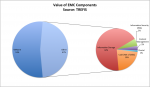
EMC floated 10% of VMware today as an IPO (NYSE:VMW) and wow, is it taking off. Starting at $29, it’s at $51 after a couple of hours of trading, making EMC’s $635 million investment in 2003 worth $19 billion today. If this price is maintained (which I doubt it will be), VMware would be half as valuable as EMC itself, according to the market. It also has a market cap higher than some other enterprise names you might have heard of: Network Appliance, Sun, Seagate, Symantec, CA…

Enterprise storage
Virtual Storage

Comments (1)

Permalink