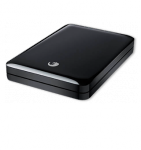
Storage capacity continues to move forward on both 3.5″ and 2.5″ hard disk drives. On the small form factor side, Western Digital was first with a 250 GB platter, then Seagate shot back with a 320 GB platter, then it was Hitachi at 375 GB. So it was only a matter of time until the magical half-terabyte mark would be reached, yielding 1 TB in a 2-platter drive. Now Seagate has done it, shipping a 2-platter 9.5 mm hard disk drive in their latest GoFlex portable case.
Terabyte home
The Four Horsemen of Storage System Performance: Never Enough Cache
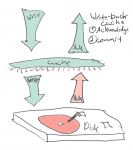
Perhaps the previous discussion of spindles left you exhausted, imagining a spindly-legged centipede of a storage system, trying and failing to run on stilts. The Rule of Spindles would be the end of the story were it not for the second horseman: Cache. He stands in front of the spindles, quickly dispatching requests using solid state memory rather than spinning disks. Cache also acts as a buffer, allowing writes to queue up without forcing the requesters to wait in line.
SMB Arrays: Drive Carriers Or Not?
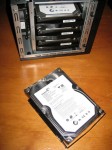
One reason I decided to work with the folks at DCIG to collect data for their Small Business Storage Array Buyers’ Guide was to learn more about the various products in the space. One difference I noted in these small arrays, which usually hold 4 to 8 drives, is their use of hard disk drive carriers or sleds. There are pros and cons to both approaches, but I was pleased to see that all arrays so far include everything needed to install a drive.
Hitachi GST Joins WD On The “Advanced Format” Hard Disk Drive Bandwagon

Another limit is being pushed in computers: The 32-bit LBA addressing mode. Hard disk drives have simply become too big for the 2.1 TB allowed by 32-bit LBA and 512 K sectors. Western Digital was first to answer this challenge with “Advanced Format”, and Seagate took an alternate 48-bit LBA route. Now Hitachi GST introduced an Advanced Format drive of their own. Will the industry ever adopt 48-bit LBA?
Review: DroboPro FS is Data Robotics SMB NAS
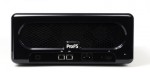
Data Robotics today launched their sixth product, the business-oriented DroboPro FS file server. Combining the 8-drive chassis from the direct-attached DroboPro with the Linux-based file server engine fro the Drobo FS, the DroboPro FS (or “Pro FS” for short) gives small businesses and remote offices a simple networked location for their shared files. Although it is a bit more expensive than some of the competition, the Pro FS promises to be as easy to set up, use, and grow as previous devices from Data Robotics.
