June 2008

Upgraded! 320 GB in a MacBook Pro!

I know I’m not the first to do this, but it does make me chuckle to have upgraded a brand new machine less than a week after buying it.  That’s right, my brand new MacBook Pro now has 4 GB of RAM and a massive 320 GB of disk space.  If you’re thinking of upgrading your disk, whether you have a Mac or PC, now might be a good time, as prices have recently hit a new low point.

Read on for details on swapping a disk in a MacBook Pro, finding a great deal on the drive, and how to get Boot Camp and VMware Fusion to work again after you do it!  Surprisingly, this was the hardest part… Continue Reading »

Share this post:
  • Digg
  • del.icio.us
  • StumbleUpon
  • Technorati
  • Reddit
  • Google
  • Slashdot
  • Facebook
  • Pownce

Apple
Personal
Terabyte home
Virtual Storage

Comments (5)

Permalink

How to Keep an IOGear KVM from Dimming Your Mac’s Screen
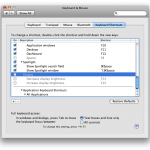
Just a quick tip tonight about something that’s been nagging me.  I love my IOGear MiniView Micro GCS632U KVM, but I’ve had a weird problem since hooking it up to my new MacBook Pro.  See, the IOGear uses a double press on the Scroll Lock key to switch views.  But every time I type this while connected to the Mac, the screen dims two notches.  Pretty quick, it’s completely black!

I just solved the problem.  The old Apple Extended Keyboard, as revered by Apple fans as my IBM Model M, continued the function key mapping past F12, adding F13, F14, and F15 where Print Screen, Scroll Lock, and Pause/Break is on an IBM 101-key layout.  Then they mapped F14 and F15 to dim and brighten the screen, respectively.  See the problem?  Yeah, the IOGear hotkey is “dim dim”!

It turns out that this is easy to fix.  Leopard’s Keyboard & Mouse Preferences panel includes a tab to remap Keyboard Shortcuts.  Down at the bottom of the list is “Display”.  Expand it and you’ll see the two mappings in question - just un-check them and you’re good to go!

While you’re there, marvel at how none of the other function key shortcuts match up to their functions on the pre-2008 MacBook uses!  It’s a really bizarre oversight on the part of Apple to map bright/dim to F14/F15 and to F1/F2 on the same computer at the same time, depending if you’re using the built-in keyboard or not!  Apparently, the company shifted all the mappings around for the late 2007 desktop and early 2008 portables, too.

By the way, about that KVM - it’s pretty good, especially for the money.  I previously used a GCS62, which is a PS/2 in and out model with no audio, but the GCS632U is more suited to weirdos like me that like to use a PS/2 keyboard and mouse with a modern computer.  It takes PS/2 in but sends USB out to the connected computers, and includes audio, too.  It’s rock-solid, unlike the Belkin Flip I tried before, but I do wish the audio cable wasn’t captive to the video like it is - it’s just not long enough for the Mac.

Share this post:
  • Digg
  • del.icio.us
  • StumbleUpon
  • Technorati
  • Reddit
  • Google
  • Slashdot
  • Facebook
  • Pownce

Apple
Computer history
Terabyte home

Comments (0)

Permalink

Command and Control: The Clash of Keyboards
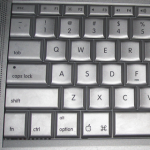
The lowly computer keyboard is so ubiquitous that it can seem unchanging, but nothing could be further from the truth.  It is one of the most important components of any system, and has survived all assaults by new technologies from the mouse to the pen to the microphone, yet its evolution is marked by legacy functions and terminology that can leave computer users scratching their heads.  Today we deal with an issue that has faced many over the past decades:  How to use a PC keyboard with a Macintosh and vice versa. Continue Reading »

Share this post:
  • Digg
  • del.icio.us
  • StumbleUpon
  • Technorati
  • Reddit
  • Google
  • Slashdot
  • Facebook
  • Pownce

Apple
Computer history
Terabyte home

Comments (1)

Permalink

Storage Virtualization: What Is It Good For?

Even though storage virtualization technologies have been on the market for 20 years or more, and numerous companies have tried to sell it as a product in its own right for at least half that long, many are still unsure of what to do with the technology.  A great new piece by Dave Raffo, News Director at SearchStorage.com, discusses the wide variety of virtualization solutions and the real impact they can have.

Dave called me for this piece, and I was pleased with the question.  Truth be told, there really are compelling benefits from virtualization, but most folks have been waiting for a real “must have” killer application for the technology.  In order for this tech to make the impact it should, we in the industry have to change some of our thinking:

  • Storage virtualization means more than just Fibre Channel block aggregation.  There are great applications inside servers and arrays and in the NAS world, too.
  • Speaking of NAS, Microsoft DFS is probably the most-implemented storage virtualization product, and just about every NAS array has cool aggregation and migration features.
  • Virtualization is a feature, not a product.  HDS has seen the amazing potential for block virtualization in migration and storage flexibility, and this is just the tip of the iceberg.
  • Storage and server virtualization go well together - so well, in fact, that ESG reports that 24% of those who have implemented the latter are also using the former!
Update: This post was apparently picked up and translated into Chinese by IT168.com.
If you’re interested in storage virtualization, why not come on out for one of my seminars on the topic?  I’ll be in Atlanta and San Francisco next week, and I think spots are still available.  I’ll be in other cities, including London (where I’ll surely change the spelling to “virtualisation”) later in the year.  Or you can catch my one-hour session at Storage Decisions in San Francisco or New York.  See you there!
Share this post:
  • Digg
  • del.icio.us
  • StumbleUpon
  • Technorati
  • Reddit
  • Google
  • Slashdot
  • Facebook
  • Pownce

Enterprise storage
Personal

Comments (2)

Permalink

Big Little Disks Are On The Way

The relentless march of hard drive capacity is about to reach its next cantonment as 500 GB 2.5″ drives begin to arrive this month.  These little half-terabyte wonders will continue the downward pressure on price and challenge flash-based drives just as they stake their claim in the main stream of the market. Continue Reading »

Share this post:
  • Digg
  • del.icio.us
  • StumbleUpon
  • Technorati
  • Reddit
  • Google
  • Slashdot
  • Facebook
  • Pownce

Enterprise storage
Terabyte home

Comments (0)

Permalink

Switch Day 1: This Mac is Hot!

So the Mac has joined my replacement work Dell - two new computers in two days!  Here are my first thoughts on the hardware:

  • The MacBook Pro is much sturdier than the average PC notebook, and even somewhat better than the high-end machines I’ve used (like my replacement Dell XPS M1330)
  • The machine is hot on the bottom when using it a lot, and even pretty hot on the top!
  • The fan is really loud - much louder than I was expecting
  • The MagSafe power cord is cute but very delicate - I’m not surprised at all that they break and burn right and left!
  • The screen is gorgeous - I got the matte model rather than the glossy since I hate the bright reflections I always fight with on my other machines
  • I wish the 15″ model I got had more than two USB ports - I just know I’m going to be swapping a lot more than I used to.  But the new Dell has only two ports, too - my old XPS M1210 had four!
  • Since I got the older model, it included the Apple remote, which is cute
  • Everything about this machine is classier and more elegant than any PC I’ve ever used, from the packaging to the case to the documentation to the power cord
  • I hate the auto-dimming screen - it reacts WAY too fast, constantly dimming and brightening as my shadow falls over the left-side speaker grille. This was the first Mac feature to be disabled!
One really odd thing about this machine is that even though it’s a “Late 2007″ model, it was manufactured in April 2008!  Why on earth did Apple continue making the old model two months after it was replaced in February with the “early 2008″ version?
As for OS X Leopard, I’ve just begun exploring…
  • Anyone who complains about UAC on Windows should try OS X - it interrupts just about as much but forces you to type in your password, too!
  • I love the packaging system - everything is self-contained so you can just drag and drop or delete
  • It took me the longest time to figure out how to be able to shut the lid and use the computer with an external monitor - turns out it always sleeps when you shut the lid but then wakes up again when you click the mouse or type on the keyboard
  • The included applications look much more useful than the ones that ship with Vista, which themselves are far better than anything Microsoft bundled in the past - I can’t wait to use iMovie and Garage Band, and iPhoto seems just as good as Google’s Picasa
  • I’m loving the included UNIX utilities - ssh and scp should be part of every operating system out of the box!
  • It’s ridiculously hard to change the hostname - apparently you have to edit /etc/hostconfig by hand!  Do they expect that no regular people want to name their computer?!?
  • Network setup beats Vista hands-down!  It correctly suggested that my wireless router was filtering based on MAC address, while Vista just said “can’t connect”
  • I already installed Boot Camp and VMware Fusion with a Windows Vista partition - talk about easing the transition!
I’ll keep updating the blog with my experiences over the next few months.  As a reminder, I offer separate feeds for Enterprise Storage for those not interested in this topic, which will be posted in my Terabyte Home feed.
Share this post:
  • Digg
  • del.icio.us
  • StumbleUpon
  • Technorati
  • Reddit
  • Google
  • Slashdot
  • Facebook
  • Pownce

Apple
Personal
Terabyte home
Virtual Storage

Comments (3)

Permalink

Switch! or How the Mac (Finally) Won Me Over

Macintosh SE, Wikimedia Commons image by DanamaniaIt’s official, I am a switcher.  A splitter.  An ex-Windows user (at home, at least).  Today I bought my first Mac since the SE that still haunts our basement storage room in its cute gray carrying bag.  Come Friday, I will be an official Mac user!

How did it come to this?  It’s not really Microsoft’s fault.  I use Vista every day for work, and have come to terms with it (most of the time).  And much of my work revolves around Server 2003 and other Microsoft server and storage technologies, which I have come to respect.  No, it’s not because of Microsoft’s software; it’s all about hardware.

Attrition was the instigator.  My home machines have been slowly dying, killed off by old age.  Last to go was my home-brew Celeron 4-powered desktop, which recently ate its second power supply, and the fact that my work laptop kicked the bucket last week.  This left me with an ancient Pentium III laptop to struggle with, until Dell fixed the work lappie (it cooked its CPU!).  But I like to keep work separate from pleasure, so I saw this as a sign that I had to get busy and get a new home machine.

But what to get?  I do lots with the home PC - video editing, photo manipulation, web work, and writing.  I’ve always relied on a desktop for these things, and have built a series of them from components over the last decade.  But I’ve become less interested in tinkering with hardware lately and more interested in having something that works.  And while there are certainly hundreds of choices for sweet pre-built and supported rigs, I finally admitted to myself that I would use a laptop more than a desktop, so the field was narrowed.

But what laptop to get?  There’s such a variety these days, from the ultra-light to the budget/mainstream to the workhorse to the crazy.  I’ve always liked my Dells, but the XPS M1210 I rely on for work hasn’t been as stellar a performer as I had hoped.  I used to be an ultra-light aficionado, with original HP OmniBooks (300 and 800CT) and Toshiba Portege 3010 haunting my past, but this class could never keep up with demanding apps like video editing and encoding.

Yes, it had to be a powerful “desktop replacement” machine with fast storage, lots of RAM, and good video hardware.  Hello, MacBook Pro!  Not being totally insane, the 15-incher would have to do.  And not being made of money, I was looking for a good deal.  Although Apple just updated the line in February, the modifications were slight - a smaller and cooler Penryn CPU, a larger hard disk, and that weird too-small multi-touch trackpad.

So I decided to pick up an “outdated” mid-2007 model instead, saving 20% in the process and still getting a killer machine.  I went with the 2.2 GHz model, betting that the 4 MB of cache in its Merom core would bring it close to the performance of a 3 MB-equipped 2.4 GHz Penryn, and would certainly be good enough for my use.  I don’t think I’ll miss the additional 128 MB of VRAM in the new ‘Books either, and the old model still has the 800 MHz Santa Rosa chipset and LED backlight.

Looking around, I found that Mac Connection and Amazon both had good prices on older gear, but MacMall had the lowest price (after a $150 rebate) and wouldn’t charge sales tax.  They talked me into a $100 RAM upgrade (to 4 GB), though I balked at their $40 installation charge.  It may be harder to swap a hard drive in a Pro, but RAM is simple to install.  I’ll live with the 120 GB 5400 RPM hard drive for a while.  But I’ve already got a 160 GB drive on the shelf, and might even skip that in favor of a 320 GB or even 500 GB Samsung at some point.

And Mac OS X?  Well that will be a learning process for me. I like the idea of UNIX internals, being an old-school UNIX-head, but am concerned about just how good the OS integration is.  Is it lipstick on a warthog like so many other “desktop UNIX” systems?  It sure looks pretty, and I love the bundled applications, so we shall see.

And I can always run Vista or XP, since the machine will definitely be a dual (or triple or quad) booter.  I went ahead and picked up VMware Fusion at the same time, hedging my bets on the state of Mac applications.

So tune in over the next few months and I’ll let you all know how it progresses.  At the very least, I got a killer new laptop!

Note to subscribers:  If you’re not interested in Macs, iPhones, home media servers, and such, you can subscribe to my Enterprise Storage-only feed.  Alternately, if you’re interested in the tales of a switcher more than Fibre Channel and iSCSI, you can subscribe to my Terabyte Home feed instead.

Macintosh PowerBook Pro image courtesy of Apple.  Macintosh SE image from Wikimedia Commons, taken by Danamania.

Share this post:
  • Digg
  • del.icio.us
  • StumbleUpon
  • Technorati
  • Reddit
  • Google
  • Slashdot
  • Facebook
  • Pownce

Apple
Terabyte home

Comments (8)

Permalink

Download Storage Decisions Presentations

Whether you were at the show or missed it, most of the presentations from Storage Decisions in Chicago are now available for download.  These can be a great resource for internal communication and strategy - share the insights from the show to help make a case for change!

Most of the sessions were worthwhile, but I’d like to highlight a few of the sessions that I attended:

My two sessions are also available:

Share this post:
  • Digg
  • del.icio.us
  • StumbleUpon
  • Technorati
  • Reddit
  • Google
  • Slashdot
  • Facebook
  • Pownce

Enterprise storage

Comments (1)

Permalink

Justifying Email Archiving

Now that my TechTarget Virtual Seminar on email archiving is finished, I wanted to share the questions and answers from the session here.  You will eventually be able to catch a recorded version of the presentation on TechTarget’s searchexchange.com site, and I’ll post when it’s out.

Interestingly, most questions revolved around justifying the purchase of email archiving solutions.  I didn’t capture all of the questions, but will try to summarize the justification-related ones here.

How can a small company archive email?

Although email archiving is expensive, it is critical to almost any organization.  Luckily, there are options for most people.  At the most minimal, you can roll your own archive by “forking” messages into a redundant email system using mail forwarding rules.  Many folks use open source UNIX mail servers for this since they’re especially inexpensive.  Next, consider Exchange 2007’s managed folders as a way to build a basic but fully-supported archiving system.  Another idea is to think about a managed service - many of these are much less expensive to set up than building a solution in house.  Finally, look around and you might find that there are indeed much more affordable products than the “big names” many people have heard about.

Archiving solutions tend to be very expensive for enterprises, what is the trade-off?

Archiving solutions are very expensive indeed. They are difficult to justify on purely cost (IT infrastructure) basis. You must bring the legal and business people to the table and get their buy-in to justify the cost. Simply put, email archiving is expensive but e-discovery is much more expensive. With the backing of the legal organization, the cost justification looks much more positive.

What should be considered to account for email archiving for D/R scenarios?

Another great question! Many managed solutions include integrated DR for the system, but may not capture messages during a disaster or communications interruption. Local solutions tend to rely on conventional DR concepts like synchronous replication. Again, this technology (and especially the telecom to support it) is very expensive, but the cost can be justified for some when balanced against legal risks.

I’ll post more Q&A from my upcoming Storage Virtualization Seminars in Atlanta and San Francisco as well as my Storage Decisions appearances in the coming months.

Share this post:
  • Digg
  • del.icio.us
  • StumbleUpon
  • Technorati
  • Reddit
  • Google
  • Slashdot
  • Facebook
  • Pownce

Enterprise storage

Comments (1)

Permalink

Amazon MP3 Friday 5

I know this will sound like an ad, but please don’t take it that way.  I love Amazon’s selection of MP3 downloads - they’re DRM-free and uniformly cheaper than iTunes.  And the company has a download app that integrates nicely with iTunes (unlike the eternally-borken Emusic manager).

I was surprised this morning with an email from Amazon touting “five albums for $5″ on the MP3 store.  Turns out, it’s five albums (today only) for $5 each.  And it’s a great set, too - I already own and love two of them, bought a third, and suspect most folks already have the fourth:

  1. R.E.M.’s new album, Accelerate is just great - short, snappy, easy to get into
  2. Radiohead’s In Rainbows is an album I’ve written about before
  3. I’d been enjoying songs from She & Him lately, including their appearance in Paste magazine, so decided to pick up Volume One for five bucks.
  4. Does anyone not know Hotel California?
  5. Finally there’s Dreaming Out Loud from OneRepublic, which I’m not familiar with.

Also, if you like the Black Keys, you can get their new Attack & Release for $2.99…

Like I said, I’m not trying to advertize this.  I’m just happy to see some great music offered legally and without DRM for low bucks.

Share this post:
  • Digg
  • del.icio.us
  • StumbleUpon
  • Technorati
  • Reddit
  • Google
  • Slashdot
  • Facebook
  • Pownce

Personal
Terabyte home

Comments (0)

Permalink