greenBytes Embraces and Extends ZFS

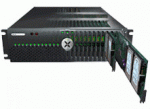
I’ve long hollered that ZFS is a real storage revolution in the making, but recognized that it still had a way to go before replacing UFS, HFS+, and most volume managers. Well, a little Rhode Island company called greenBytes comes out of stealth today to announce that they’re doing just that - taking the solid ZFS core and adding some serious enterprise storage features to it. And they’re rolling the lot into a multi-protocol storage array using commodity (Sun Thumper) hardware. These guys have cooked up a seriously interesting entrant in the storage market, though I can’t say much for the decapitated camel-case spelling of their (already in use) name!

Continue Reading »

Enterprise storage
Virtual Storage

Comments (2)

Permalink

Turning the Page on RAID

This is part of an ongoing series of longer articles I will be posting every Sunday as part of an experiment in offering more in-depth content.

It has been the core technology behind the storage industry since day one, but the sun is setting on traditional RAID technology. After two decades of refinement and fragmentation, we are abandoning the core concepts of disk-centric data protection as storage and servers go virtual. Next-generation storage products will feature refined and integrated capabilities based on pools of storage rather than combinations of disk drives, and we will all benefit from improved reliability and performance.

Continue Reading »

Computer history
Enterprise storage
Virtual Storage

Comments (2)

Permalink

Sun’s Excellent VirtualBox Goes 2.0

Today, Sun released VirtualBox 2.0, a major revision to the (partially open source) desktop virtualization software. I have long used VirtualBox on my Windows machines as my virtualization product of choice due to its compactness, functionality, and low impact on the host system. Although I’m happy with VMware Fusion on the Mac, I intend to try out VirtualBox there, too, to see how it compares.

If you haven’t already tried VirtualBox, you ought to. It works very well, virtualizing Windows and Linux guests on Windows, Linux, Solaris, and Mac hosts with respectable performance. One thing I really love about it is that it doesn’t bog down my Vista system like VMware with installed drivers and services. It just installs and works and gets out of the way when you’re not using it.

VirtualBox supports shared folders, USB, and has guest additions for Windows and Linux to provide resolution independence and performance boosts. The new 2.0 version adds 64-bit guest OS support for 64-bit hosts along with performance and stability fixes. The Mac version now has a native look and feel and better networking, too.

One really interesting twist for folks interested in desktop virtualization (aka VDI on VMware) is integration with remote desktop protocol (RDP). VirtualBox guests can be configured to act as RDP servers, with thin(ish) clients accessing them over a network and even sharing their USB devices seamlessly. I’m getting pretty excited about the desktop virtualization concept - I’ll be keeping my eyes on companies like stealthy Old Road Computing Virtual Computer to see what they’re up to!

Apple
Virtual Storage

Comments (0)

Permalink

Grapples and Tangelos: Why it’s Impossible to Compare Fairly

I get the same questions all the time: Should I buy X or Y? Is Z better than Q? But as much as it sounds like a cop-out, I always answer, “well, this sounds like a cop-out, but that depends on what you’re doing with it…”

Now EMC’s Chuck Hollis has (bravely) stuck his neck out to try to actually compare the capacity efficiency three storage arrays in a realistic way. Good luck, Chuck! I can hear the knives sharpening over at NetApp and HP already!

Continue Reading »

Enterprise storage

Comments (3)

Permalink

Storage Fixes in VMware ESX Server 3.5 Update 2

VMware just released Update 2 for VMware ESX Server 3.5 (Virtual Infrastructure), and it includes some storage fixes of note:

  1. Support for Volume Shadow Copy Service (VSS) for filesystems Windows Server 2003 and Windows Server 2008 guests.  This means VMware services like VCB and SRM can now signal Windows Server to quiesce filesystems before creating a clone or snapshot and is a major addition!
  2. Windows Server 2003 guests also get application quiescing, where supported.
  3. You can now extend a live, running VMFS volume as storage is added, just like Windows Vista and 2008 guests could already do with raw device mode (RDM).  Note that this only works for flat disks with no persistent snapshots open.

Continue Reading »

Enterprise storage
Virtual Storage

Comments (3)

Permalink

The Artist Formerly Known As Network Appliance

Dancing around a Stonehenge dolmen at Summer solsticeNetwork Appliance is no more. The company that made the second enterprise storage device I ever used, added the terms “filer” and “appliance” to the enterprise IT lexicon, and long suffered from a confusing array of names, is now officially called NetApp.

This is probably a good idea. A company needs a single name, and NetApp is what lots of people (even me) have long called the company. Plus, it’s never good to have your company name be the same as one of your products, at least when you make more than one. And NetApp has lots of different products, many of which are not network appliances

They’ve added a new logo, too, which ironically looks like a thick blue dolmen to me, but was probably supposed to evoke a door and the letter, N. I always liked the old round peg in a round hole idea, myself… But then again, I always kinda liked yellow and purple and silver storage devices, too!

Remember the old days, when it was Apple Computer, HP still stood for Hewlett-Packard, Sun for Stanford University Network, and EMC for Evil Machine Company? (Just kidding, guys, I know it was Egan, Marino and Einstein’s equation…) But the world will end if IBM ever changes its logo!

Update: More coverage:

Image by Andrew Dunn courtesy of Wikimedia Commons, cc-by-sa-2.0

Computer history
Enterprise storage

Comments (3)

Permalink

ZFS: Super File System!

ZFS really piques my interest, so I just had to include it in my TechTarget storage virtualization seminar series.

Here’s a quick primer for those of you who aren’t familiar with it, and thus are wondering why anyone would get stoked over a filesystem!

ZFS (originally “zettabyte file system” but now just ZFS) takes the essential technolgy from file systems and volume managers and stirs it together into one important new way to manage storage.  It’s an open source project started and managed by Sun, using the CDDL license (so Richard Stallman wouldn’t approve).  It’s loved by both Sun and Apple which makes it much more important.

See, ZFS will probably replace UFS (on Sun), HFS+ (on Mac), and every other file system and volume management product out there, especially on these platforms.  And I expect to see it appear on Linux once the tricky bits are resolved (which have to do with licensing not technology…)

ZFS creates a truly flexible, extensible, and full-featured pool of storage across systems and disks.  No more (of the old) arcane syntax, commands, ridiculous GUIs (ahem, Sun), and unnatural limitations of old system storage management.  With ZFS, you add some disks, get some space, and use it.  But it gets cooler than that…

ZFS “zpools” (file systems) live on “vdevs” with striping and optional RAID-Z/Z2 (which is double-parity kinda like RAID-6).  And, get this, every block is protected with checksums to ensure that the rapidly rising incidence of disk errors won’t bite you.  Want capacity?  128-bit addresses mean near-infinite space (in theory).  Oh, yeah, and all blocks are “copy-on-write” for snapshots and clones, something that barely works on most desktops and workstations.

But alas, there are some limitations…  Adding (and especially removing) vdevs is hard (read: maybe impossible) depending on how your storage was set up.  Stacked RAID is impossible, so no “Z+Z2″ for you!  And, until Sun integrates Lustre, there is no clustering support.

And then there’s the fact that Sun and Network Appliance are actively suinging each other over the fact that the technology in ZFS has ended up looking an awful lot like their bread and butter super file system, WAFL.

So there you have it.  If you’ll be in Washington DC on March 4, or Durham NC on March 6 and are interested in this topic, and the wider world of storage and server virtualization, I’d love for you to register and attend this free seminar!

Apple
Enterprise storage
Terabyte home

Comments (2)

Permalink

Yowza! VMware is a Rocket!

EMC floated 10% of VMware today as an IPO (NYSE:VMW) and wow, is it taking off. Starting at $29, it’s at $51 after a couple of hours of trading, making EMC’s $635 million investment in 2003 worth $19 billion today. If this price is maintained (which I doubt it will be), VMware would be half as valuable as EMC itself, according to the market. It also has a market cap higher than some other enterprise names you might have heard of: Network Appliance, Sun, Seagate, Symantec, CA…

Enterprise storage
Virtual Storage

Comments (1)

Permalink

Storage from behind the great wall

Yes, folks, China is rising in storage industry. A while back, my good friend Marc Staimer suggested that Huawei might become the next great storage vendor. Well, Huawei’s joint venture with 3Com has now become 3Com’s unit in China, H3C. That’s right, Bob Metcalfe’s old company bought Huawei out of the venture this year in an attempt to regain the number two market position in networking. And since H3C has long had a strong interest in the storage side of the network, we might see 3Com attack the low end of the storage industry next year!

H3C already has a long list of products, most based on in-house hardware and OEM software. On the storage side, the company makes an iSCSI storage array platform dubbed “Neocean”. This storage platform, selling strongly in China, is alleged to leverage technology licensed from FalconStor (on the low-end IX1000), Intransa (on the bigger IX5000), as well as iVivity and Xyratex. OEM storage developer Ciprico today announced that it will be working with H3C on the next generation. H3C also sells a WAFS accelerator leveraging Expand Networks software. All of these should be coming to the United States next year.

Huawei itself is also getting back into the storage market in the form of a joint venture with Symantec, creatively called Huawei-Symantec. This company is set to be coming out with a line of network devices with Veritas-based software built in. We’re hearing about virus scanning and content indexing appliances, as well as NAS and SAN arrays which will include storage foundation software from Symantec right out of the box.

Who knows what’s next from Huawei? I’d guess expanded services, more resellers in the West, and more OEM deals to create bigger systems. In a few years, they might give Hitachi and EMC trouble in the enterprise market, especially when big server vendors like Sun, SGI, Dell, and HP start rethinking their OEM strategies…

Enterprise storage

Comments (0)

Permalink