The Future of Home Storage

Homes now need data storage as well as closets...

Homes now need data storage as well as closets...

This is part of an ongoing series of longer articles I will be posting every Sunday as part of an experiment in offering more in-depth content.

Along with my professional focus on enterprise storage systems, I’m enamored of home networking, and recently passed the three terabyte mark at home! This got me thinking about where home storage is heading.

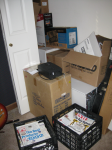
As you can see in the photo, my office closet is overflowing with computer equipment (and one sweet guitar), but my data storage is much better organized. I have a hacked Linksys NSLU2 with 500 GB as a file server, a 500 GB PC backup disk, a 160 GB Time Machine disk, 1 TB of TiVo storage, and the rest. But wouldn’t it be nice if this could all be combined into some kind of super home server?

Continue Reading »

Apple
Computer history
Terabyte home

Comments

Permalink

No More CDs

So yesterday we finished ripping our entire CD collection - we’ve now completed our switch to digital music at home.  It’s done.

It amuses me to think of the statistics:

  • We have 11,284 tracks stored, including 279 Christmas songs and 549 kids songs!
  • Most songs were ripped using LAME at the VBR3 setting in joint stereo
  • This music library takes up 58 GB of storage on my NSLU2/Firefly server
  • The jewel cases take up six large cardboard boxes, but the original discs take up just two fat CD storage books

We’ve quickly adapted to a hierarchical model for home music distribution.  The main server has everything, so our two Roku Soundbridge players play directly from it.  But we also use iTunes on three machines, and have imported a subset of the music to each based on personal preference.  From these iTunes implementations, we sync a sub-subset to our iPods - a 40 GB click wheel, two iPhones, and two Shuffles.

Although our TiVos can play MP3 files over the network, we don’t bother.  It just seems wrong to turn on the TV to listen to music…  Similarly, we don’t use Windows Media Player for much of anything, even though it’s compatible with the Soundbridges and media server.

We listen to a lot more Internet Radio than I thought we would, too.  Sometimes we’ll even tune in WKSU over the Internet rather than hoping for good FM reception.  And I’m listening to WBUR a lot again, too.

I’ve also started to rip DVDs to watch on the iPhone, and am storing these on the NSLU2 too.   Add in the iPhone versions created automatically by TiVo Desktop Plus, and I’m amassing a large collection of H.264 media.  In fact, I’ve already got 50 GB of H.264 video stored up there!  Makes me want to go get an Apple TV so I can easily watch it at home.  Is the end of the DVD coming soon, too?

Apple
Personal
Terabyte home

Comments

Permalink

Another Roku Soundbridge

So I loved the original Roku Soundbridge I bought for the main stereo so much that I couldn’t resist buying a second one when I spotted it on clearance at Best Buy. Now I’ve got one in my office, too.

I wonder why they decided to clear it out. It was brand new, and had never appeared on their shelves that I noticed. It couldn’t have been displayed for more than a month or two since it was the new 1001 model. Oh well, their loss, my gain!

I’ve also monkeyed with my media server. I was running Unslung as my OS on the NSLU2, but I got sick of its weirdness, and it kept running out of memory. So I wiped it and went for SlugOS/BE (aka OpenSlug), a very trimmed down OS for the Slug. The Firefly Media Server people don’t officially support it, but I was able to get it running in short order. It seems much more stable and responsive. And I replaced the old Linksys build of Samba with version 3, which is much speedier and uses far less CPU time. I’m happy!

As an aside, did you know that Best Buy will haggle on their clearance items? Ask the manager, and they can easily knock off 15% to 25% from the yellow-sticker price!

Personal
Terabyte home

Comments

Permalink

Making the Switch to Digital Music at Home

After sticking staunchly to real CDs for home listening, I finally succumbed and expanded my terabyte house into the digital audio server domain. In the end, it was audiophile Mark Schlack from TechTarget who won me over - if digital audio is good enough for him, then it ought to be good enough for me!

Although both of my TiVos can browse and play mp3 files, they require the television to be on and a special server running on a PC (or so I thought, more on that later). It was critical that any digital music solution be directly browsable and searchable using a remote control, since the kids perk up whenever they hear the big tube on our Sony TV burp to life.

Although there are a good many home music players available, two immediately rose above the rest: the Slim Devices Squeezebox, and the Roku SoundBridge M1001. Both are somewhat similar in that they are designed to connect to a home network and browse and play digital music in a variety of formats to an audio receiver. I rejected out of hand all those devices that lacked their own display, sadly including Apple’s intriguing AirPort Express with Air Tunes.

My research quickly revealed that the Squeezebox was the audiophile-preferred solution with its fancy Burr-Brown digital audio converters, while the SoundBridge was the hackers choice with its open interfaces and wider server compatibility. It was widely claimed that only the Squeezebox supported lossless codecs, but I found that this was not the case - although FLAC must be transcoded, the SoundBridge does support ALAC and even WAV for high quality audio. The difference in DACs made no difference to me, since I would be using a digital (S/PDIF) connection to bypass the SoundBridge’s DAC in favor of the one in my Denon receiver.

In the end, the flexible SoundBridge won me over with its wide range of interfaces. It can browse and stream an iTunes library directly, since Roku licensed Apple’s DAAP API. There are a variety of other DAAP servers that can use, too, including Slim Devices Slimserver! But I settled on the open source Firefly (nee mt-daapd) server, since it was full featured, and lightweight enough to run on an embedded NAS server like the Linksys NSLU2, which I intended to add in short order. The SoundBridge also has an open API and telnet interface!

Making my choice even sweeter, at $127, the SoundBridge was half the price of the Squeezebox, too! I placed my order, and thenerds.net delivered it the very next day, even though I chose ground shipping!

The SoundBridge is amazing! It does exactly what I wanted, letting me listen to the tunes stored on my wife’s and my laptop as well as my home PC server without any configuration required. Once I discovered that you can quickly move from letter to letter with the right and left buttons, locating the right song from our 7800-tune collection could not be easier either.

The one major letdown that I had is that Apple will not allow any other hardware, even under license, to play the protected m4p files purchased from iTunes. Although most of my music is ripped from CD, I have got a few dozen iTunes purchased songs. There is a way to crack that DRM protection on these files, but it galls me to have to hack them open just to listen to them!

All in all, I’m very pleased with my new digital music solution at home. I’m seriously considering buying Roku’s SoundBridge Radio, which would let me wirelessly browse and play music anywhere within range of my access point. And I did add that home server - more on this next time.

Apple
Personal
Terabyte home

Comments

Permalink

Where is Linux in Storage?

Marc Farley’s challenge of listing all the devices on our home networks got me thinking –I’ve got an awful lot of Linux devices, but all of them are infrastructure rather than interactive PCs. Of the 10 devices currently attached my home network, four are Linux based (two TiVos, a Linksys router, and Linksys NAS), three are Windows PCs (two Vista, one server 2003), and the rest run various embedded operating systems (a Roku SoundBridge, an HP printer, and a 3Com Audrey running QNX).

Notice that all of my PC’s run windows, while all of my servers run Linux! This got me wondering what role Linux plays in enterprise storage. Sure, Linux has a huge role to play on the computing side of the equation. But which enterprise storage devices are based on a Linux kernel?

Xiotech made a big splash a few years ago by announcing that they would switch from a proprietary operating system to Linux. I remember seeing Open-E’s Linux based iSCSI software somewhere, and hearing that Snap Appliance (now part Adaptec) of was using it as well. I consulted LinuxDevices.com and found out about Infrant (now part of NetGear), MaXXan (nee CipherMax), and Raidtec.

There have got to be more! So tell me, who is using Linux as their embedded kernel and why? Was it for convenience, hardware support, or perhaps a financial decision?

Computer history
Enterprise storage
Everything

Comments

Permalink