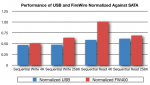
Yes, FireWire is Faster Than USB

This should not come as a shock to anyone, as it has been proven before, but let me take this moment to say that, yes, despite their rated speeds, 400-megabit FireWire S400 (aka IEEE 1394) is faster than 480-megabit USB 2.0.

While swapping out disk drives (first to upgrade the internal drive in my MacBook Pro and later to give Time Machine more room), I took some quick performance snapshots with xbench and showed that, depending on I/O type, FireWire can be almost twice as fast as USB, but neither really holds a candle to SATA.

I also took the opportunity to compare the highly-integrated USB 2.0 controller in my Maxtor OneTouch 4 Mini with the much more complicated FireWire/USB combo found in the Verbatim SmartDisk, as well as the performance of three popular notebook hard disk models.

Continue Reading »

Apple
Terabyte home

Comments (1)

Permalink

Big Little Disks Are On The Way

The relentless march of hard drive capacity is about to reach its next cantonment as 500 GB 2.5″ drives begin to arrive this month.  These little half-terabyte wonders will continue the downward pressure on price and challenge flash-based drives just as they stake their claim in the main stream of the market. Continue Reading »

Enterprise storage
Terabyte home

Comments (0)

Permalink

Custom Icons Keep Removable Drives Straight

Update: I have created another page for custom drive icons in Mac OS X

If you’re like most people, you have accumulated a large number of removable USB storage devices over the years, from flash-based thumb drives to external hard disks.  I have seven of these things sitting on my desk or in by laptop bag right now!  But Windows XP and Vista uses the same icon for all of them, adding a few seconds of examination every time I try to select one.  Icon confusion can cause problems too, like the time I accidentally saved a presentation to my big desktop backup drive instead of the thumb drive I headed out of the office with!

Ugly - no drive icons

Before: Everything looks like a generic external book type thing.

But I’ve stumbled on a great method to create easy to locate the right drive using free software and the power of Google.  I create a custom drive icon that looks like the physical drive in Windows, so I can see which is which at a glance.  Here’s how!

An (over)abundance of beautiful drive icons

After: Aah, now I can see which removable drive is which.  Shame about that iPhone icon, though…

Continue Reading »

Personal
Terabyte home

Comments (1)

Permalink

Seagate Going to China?

The stock market was alive with rumors that Seagate might be bought by an unnamed Chinese company, as reported in the New York Times, among others. This comes after a week of insider whispers about a possible tieup between Seagate and memory-makers, Micron or SanDisk, itself a Seagate spin-off. It seems that the hot disk drive and flash memory markets are shaking as sales heat up and margins thin out. Note that this is far from a done-deal. Rather, Seagate CEO, William Watkins, was merely noting in an interview that there was such an inquiry.

To my eyes, a Seagate buy-out would be little different from the sale of IBM’s disk drive operations to Hitachi back in 2002 or their sale of the PC group to Lenovo two years later. Seagate is a component maker, and although it is a critical piece of the storage industry it is not really a strategic entity. Certainly, the company’s contributions to standards like SATA, SAS, and (yes) hybrid drives are worthwhile, but apart from evault, the company contributes little to the value-added services landscape.

Still, if a buy-out softened scrappy Seagate I would miss the healthy contribution between them, Western Digital, Hitachi, and the other disk vendors. And it would be an end of an era, with Alan Shugart’s old company going the way of MG Rover and the rest.

Computer history
Enterprise storage
Terabyte home

Comments (1)

Permalink

Commercial SSDs Are Here?

Anyone paying attention knows I’m not particular sanguine about the near-term prospects for solid-state disks (SSDs) and hybrid hard disk drives (H-HDDs) in the enterprise storage space, but I’m not foolish enough to discount them entirely. With that in mind, it’s worthwhile noting the debut of the first commercially-available retail(ish) SATA SSD from SanDisk. Read more below… Continue Reading »

Enterprise storage
Terabyte home

Comments (5)

Permalink

Water-Cooled Hard Drives

It seems that water-cooled storage isn’t just for IBM spinoffs anymore! NEC and Hitachi have unveiled a new water-cooled hard drive module for PCs (in Japan) to keep their drives nice and cool (and quiet, too!)

Don’t expect to see this tech widely used, though. It’s way too complex for mainstream application.

Once again, in the words of Mystery Science Theater 3000, “Trumpy, you can do stupid things!”

Enterprise storage
Terabyte home

Comments (0)

Permalink

Specialized Server/Enterprise Hard Drives

Continuing my overview of the specialized hard drive market, we move on to the world of enterprise hard disk drives. These are performance monsters, with nearly all falling above the 10,000 RPM line that defines “exotic” in the desktop space. They also have a wide variety of interfaces, including parallel and serial SCSI, Fibre Channel, and even SATA.

Lots of innovation is currently on the horizon in the enterprise drive space, notably the application of desktop and mobile technologies to the space. Right now, you can buy a 15,000 RPM 2.5″ dual-SAS enterprise mechanism from two different companies! Or maybe you want a 1 TB bulk drive with SATA? These are a far cry from the bread and butter 10- and 15k 3.5″ SCSI and FC drives we’ve long been accustomed to. Click through for the full story… Continue Reading »

Enterprise storage
Terabyte home

Comments (2)

Permalink

Specialized Desktop Hard Drives

I will begin my overview of the specialized hard drive market with the ubiquitous desktop disk drive. While just about any drive could be used in a desktop computer, the class is generally defined by what it lacks - compact size, power efficiency, exotic interfaces, special drive features, and high performance are all generally not required.

My survey did reveal a surprising range of devices, even given these limited requirements. Although no 5400 RPM drives are currently being sold for desktop use, there is (one) 10,000 RPM desktop drive! And a few of the larger drives are showing up with mondo caches - up to e32 MB! I bet these cache sizes will put the squeeze on hybrid drives…

Really, desktop drives are mostly notable for what they are doing to the enterprise market, which I’ll cover tomorrow. But for now, click through for the full story on the desktop drive market!

Continue Reading »

Enterprise storage
Terabyte home

Comments (0)

Permalink

Specialized Hard Drives: Worth the Effort?

Lately, there has been a lot of buzz in the enterprise storage arena about whether so-called “enterprise drives” are really any better than plain-Jane hard drives in Enterprise applications. This came to a head with the controversial findings of Google and CMU, but it’s been simmering under the covers everywhere from TiVo communities to gamers. I’ve normally been loathe to focus on a product so mundane as a hard disk unit in this blog, but I find that their functionality ripples up to the highest levels of strategic buying.

So what makes a great hard disk drive? It turns out that the major manufacturers have a lot of ideas, segmenting and specializing their product lines faster than anyone can keep up with it. I realized that I really knew very little about these important components and set out to learn more.

So all next week, I’m going to highlight each segment of the hard disk industry, discussing the various models of drives offered and the reality of their specialization.

I’ll be looking at drives from the following manufacturers:

  • Excelstor - An assembler from China
  • Fujitsu - A major player in the laptop/mobile and enterprise drive market
  • Hitachi - Purchased IBM’s disk drive operations and a major enterprise maker with products in nearly every market niche
  • Samsung - Quietly gaining ground in the desktop and laptop/mobile space
  • Seagate - The other full-line player in the market, especially after the purchase of Maxtor
  • Toshiba - The big dog in laptop and ultraportable drives
  • Western Digital - The consumer disk titan is starting to move into the server/enterprise territory

And I’ll be covering the following market segments:

  • Desktop
  • Server/Enterprise
  • Laptop/Mobile
  • DVR/Surveillance
  • Ultraportable
  • Automotive/Industrial

At the end, I’ll sum up my findings and opinions on this amazingly diverse market. Note that, while I focus on enterprise data storage as a professional consultant, I’m no disk drive market insider. I’m researching and learning, and I value input from others, especially on this topic!

Enterprise storage
Terabyte home

Comments (2)

Permalink

Hybrid Drives Are Here – But they’re Irrelevant to Enterprise Storage

It isn’t every day that a new hard disk technology is introduced, but Samsung recently did just that with the introduction of their SpinPoint MH80. This conventional looking SATA hard drive packs 256 MB of NAND flash memory alongside two conventional platters totaling 160 GB of traditional magnetic storage. Tellingly, it’s a 2.5” laptop drive with only 8 MB of cache.

This on board flash memory is what makes the drive a hybrid. If you listen to the marketing spin, you would think that this drive would dramatically improve response time and battery life, but a thorough review over at Tom’s Hardware shows that this isn’t the case, even for a laptop running Microsoft’s Windows Vista.

Vista is the only operating system that’s currently capable of taking advantage of the flash memory in a hybrid drive. See, these drives contain an extended version of the serial ATA command set which allows the host to direct I/O to either the flash or the magnetic platter – the drive doesn’t do it on its own.

So hybrid drives are more of a packaging exercise that a real technology improvement. They simply allow operating system to access flash memory and use it as it sees fit. While I’m certain that other operating systems, especially Linux, will quickly support this flash memory, I’m much more dubious about the long-term impact on it. Intel has their own specification for adding flash memory to an x86 motherboard called Turbo Memory (code name Robson) which is already gaining traction with many OEMs, including Apple! In practice, hybrid drives are just alternative to Robson.

So what will be the impact of hybrid drives on the world of enterprise storage? Probably very little, at least for the time being. Tests of Microsoft’s ReadyBoost technology have shown the practical impact of flash memory of operating system is small. Solid state disk technology is unlikely to gain widespread use without some real performance improvements to report, and if it ever does it would probably be implemented very differently than the current crop of hyper drives, or Intel’s Rob son for that matter. So hybrid drives are here, but no one cares.

Enterprise storage
Terabyte home

Comments (2)

Permalink